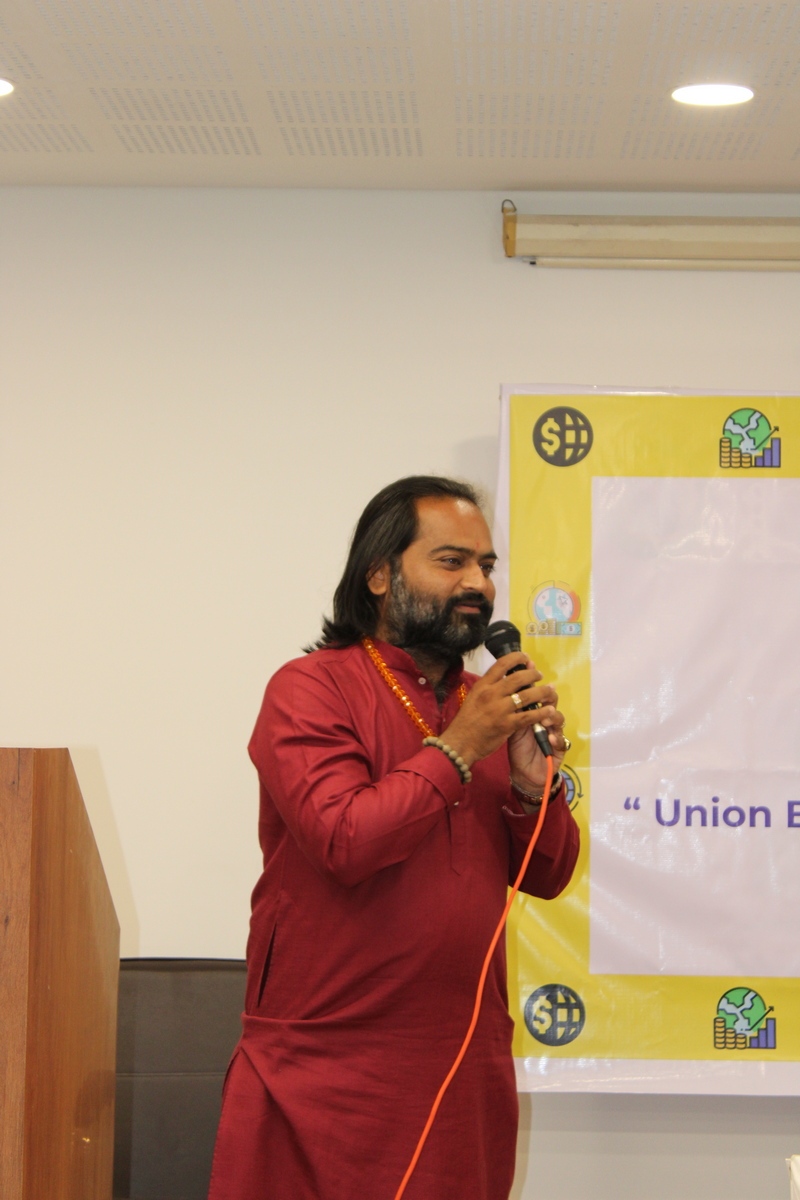
The Department of Economics, L. D. Arts College, Ahmedabad, successfully organized a One-Day Workshop on the theme “Union Budget and Society: Understanding Policy, People, and Power” on Tuesday, 10 February 2026. The workshop aimed to provide students with a deeper understanding of the Union Budget, its policy implications, and its impact on society, governance, and economic development.
The program was conducted under the leadership of Dr. Ila J. Bhola, Head of the Department of Economics, along with faculty members Dr. Vinod Meena, Dr. Jagruti Thummar, and Dr. Bhavna Parmar, whose dedicated efforts ensured the smooth and successful execution of the event.
The workshop featured two distinguished expert speakers. The first keynote address was delivered by Mr. Yamal Vyas, CA & CS, Chairman of the 4th Finance Commission of Gujarat and Pradesh Pramukh Pravakta of BJP. Drawing upon his vast experience in finance and public policy, Mr. Vyas provided a comprehensive analysis of the structure of the Union Budget, fiscal federalism, revenue allocation, and the role of finance commissions in strengthening state economies. He explained how budgetary provisions influence governance, infrastructure development, welfare schemes, and long-term economic planning. His address offered valuable insights into the relationship between financial policy and political decision-making.
The second expert session was conducted by Mr. Chandraprakash Tilak from Pune, an eminent speaker on the Union Budget who has delivered more than 3000 expert talks on Budget analysis and authored over 35 books on economics and public finance. His session was highly engaging and intellectually stimulating. Mr. Tilak elaborated on the historical evolution of the Union Budget, taxation policies, fiscal discipline, public expenditure priorities, and the socio-economic impact of budgetary reforms. He emphasized how the Budget reflects the government’s vision for inclusive growth and sustainable development. Through practical examples and analytical explanations, he enabled students to connect theoretical economic concepts with real-world policy outcomes.
Students from Undergraduate and Postgraduate programs of Economics actively participated in the workshop. The interactive discussions allowed them to raise questions regarding taxation reforms, fiscal deficit management, public welfare allocation, employment generation, and economic inequality. The workshop significantly enhanced their understanding of how economic policies directly influence society and governance.
The program was effectively anchored by Dr. Vinod Meena, who ensured smooth coordination and engagement throughout the sessions. The workshop concluded with a formal Vote of Thanks delivered by Dr. Bhavna Parmar, who expressed heartfelt gratitude to the esteemed speakers, faculty members, and students for making the event a meaningful academic success.
Overall, the one-day workshop proved to be an intellectually enriching and insightful experience. It strengthened students’ analytical understanding of the Union Budget, deepened their awareness of fiscal policy and governance, and encouraged them to critically examine the dynamic relationship between policy, people, and power. The event truly reflected the Department’s commitment to academic excellence and practical economic education.